


Dickenss England
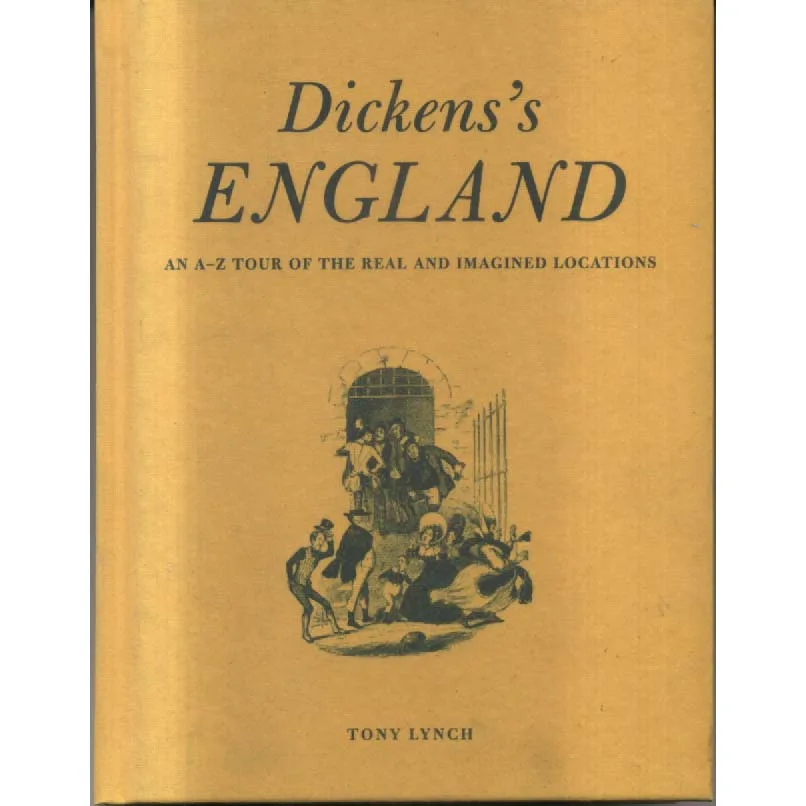
Publisher: Batsford
Format: Hardback
ISBN: 9781849940351
Dickens’s England (2012) by Tony Lynch
Batsford | ISBN: 9781849940351 | Condition: Good
There are places in England that possess history, places that possess literary associations, and then there are places associated with Charles Dickens, where even the most unremarkable street corner can become an opportunity to encounter a miserable orphan, a dishonest lawyer, an eccentric aunt or a gentleman whose principal ambition appears to be acquiring somebody else’s money. In Dickens’s England, Tony Lynch takes us on a wonderfully atmospheric journey through the towns, villages, streets and buildings that inspired one of Britain’s greatest novelists, revealing a country where the boundary between historical reality and literary invention has become so delightfully blurred that one half expects Mr Micawber to emerge from a public house and request the temporary loan of five pounds.
Charles Dickens did not merely write about England. He populated it with characters so vivid, grotesque, charming, dishonest, sentimental and magnificently ridiculous that they have become an almost permanent part of the national landscape. His London is a place of fog, poverty, wealth, crime, bureaucracy, extravagant personalities and elaborate social misunderstandings, while his provincial settings provide equally memorable glimpses of coaching inns, country towns, windswept coastlines and communities inhabited by people whose personal peculiarities would probably exhaust the patience of a modern social worker.
Tony Lynch’s book explores this extraordinary geographical inheritance, examining both the real locations associated with Dickens’s life and the fictional landscapes through which his characters wandered, suffered, schemed and occasionally achieved something resembling happiness.
The result is a literary journey through an England that has changed enormously since the nineteenth century, yet still retains surprising traces of the world Dickens knew.
Arranged as an A–Z gazetteer, the volume contains more than 200 entries covering locations across England, from London to Liverpool, Bath to Birmingham, and numerous places in between. It brings together literary history, biography, local geography and historical observation, offering readers the opportunity to discover where Dickens lived, worked and travelled, alongside the settings that inspired some of his most celebrated fictional creations.
And what creations they were.
Dickens possessed an extraordinary talent for inventing characters whose names alone seem sufficient to explain their personalities. Ebenezer Scrooge, Uriah Heep, Wackford Squeers, Mr Bumble, Miss Havisham and the magnificently named Mr Pumblechook are not individuals one could easily imagine disappearing anonymously into a crowded railway carriage.
Indeed, one suspects that modern employers would experience considerable difficulty recruiting somebody called Wackford Squeers without first consulting the company’s safeguarding policy.
London occupies a particularly important position in Dickens’s literary universe. The capital of the nineteenth century was an astonishingly complicated place, where enormous wealth existed alongside desperate poverty, where respectable institutions concealed spectacular corruption and where the unfortunate inhabitants of overcrowded neighbourhoods could find themselves struggling to survive within sight of some of the richest people on Earth.
It was a city of dramatic contrasts, and Dickens understood those contrasts with extraordinary precision.
The London of Oliver Twist contains the criminal underworld of Fagin and Bill Sikes, the workhouses and institutions through which unfortunate children were processed, and the dangerous streets where poverty and exploitation flourished. Meanwhile, Bleak House exposes the labyrinthine absurdities of the legal system, particularly the magnificent achievement of conducting litigation for so long that the original purpose of the proceedings becomes almost irrelevant.
The fictional case of Jarndyce and Jarndyce remains one of literature’s finest examples of institutional inefficiency, a process in which generations of lawyers appear capable of consuming an entire estate while producing little discernible benefit for the people supposedly entitled to inherit it.
Modern legal practitioners may understandably prefer not to discuss the similarities.
But Dickens’s England extends far beyond the capital.
The Kent countryside and marshes play an unforgettable role in Great Expectations, where the young Pip’s encounters with escaped convict Abel Magwitch establish the foundations of one of Dickens’s most powerful novels. The landscape is bleak, mysterious and wonderfully atmospheric, suggesting that the English countryside can be every bit as intimidating as London’s darkest streets, particularly when one is a small boy encountering a desperate criminal among the gravestones.
The coastal town of Yarmouth provides the setting for memorable episodes of David Copperfield, while Yorkshire becomes associated with the appalling educational establishment featured in Nicholas Nickleby.
Bath appears in the adventures of Mr Pickwick, providing a glimpse of a fashionable Georgian city whose elegant architecture and respectable social customs conceal the usual collection of vanity, absurdity and human foolishness.
Dickens travelled extensively, and his experiences supplied an extraordinary quantity of material for his fiction. He possessed a keen eye for buildings, streets, landscapes and the particular atmosphere of different places, transforming geographical observations into vivid settings that became inseparable from his characters.
There is something especially fascinating about visiting a real location associated with a fictional story. One can stand in a street, examine an old building or wander through a country landscape and imagine the events of a novel unfolding nearby, even when the actual characters never existed outside the author’s imagination.
Literary tourism is, in many respects, the respectable practice of visiting places where imaginary people did imaginary things and then feeling rather pleased to have discovered the connection.
Yet the experience can be genuinely moving.
The buildings and streets through which Dickens himself walked provide a tangible connection to the man behind the novels. His birthplace in Portsmouth, the sites associated with his difficult childhood in London, his connections with Broadstairs and Rochester, and his final home at Gad’s Hill in Kent all form part of the remarkable story of his life.
His experiences as a child working in a blacking factory were particularly important, leaving emotional scars that influenced his later portrayal of poverty, humiliation and the vulnerability of children within an indifferent society.
It is one of the extraordinary contradictions of Victorian Britain that a civilisation capable of producing enormous industrial wealth, magnificent engineering achievements and the world’s most powerful commercial empire could simultaneously regard the employment of impoverished children in unpleasant conditions as a comparatively unremarkable feature of economic life.
Dickens was well acquainted with such contradictions, and his novels repeatedly attacked the complacency, cruelty and hypocrisy that allowed them to persist.
His fictional England is therefore not merely picturesque. It is a place of suffering, injustice, social ambition and institutional failure, populated by people struggling to establish some degree of security and happiness within a society that frequently seems determined to make the business unnecessarily difficult.
This is part of what gives his writing such enduring relevance.
Modern Britain has changed beyond recognition in many respects, yet problems concerning housing, poverty, bureaucracy, social inequality and the less admirable behaviour of people possessing money and influence have proved surprisingly resistant to complete eradication.
One suspects that Dickens, if transported into the twenty-first century, would find much to admire in modern society, particularly its scientific and technological achievements. He would also discover an abundant supply of material for new novels, especially after attempting to contact a large organisation’s customer service department or navigate an automated telephone system.
Tony Lynch’s exploration of Dickensian locations allows readers to appreciate the geographical foundations of this extraordinary literary imagination. Many of the buildings Dickens knew have disappeared, demolished through redevelopment, war damage or the ordinary determination of successive generations to replace old structures with something considered more commercially useful.
Others survive, sometimes in altered form, providing fragments of historical continuity amid modern streets and buildings.
There is something particularly appealing about discovering a surviving Dickensian location surrounded by the products of contemporary urban life. A narrow street that once inspired a scene of Victorian poverty may now contain fashionable restaurants, expensive apartments and a coffee shop selling beverages whose prices would probably have caused Mr Micawber considerable distress.
The architecture remains, but the inhabitants have changed, along with their expectations of plumbing, sanitation and domestic comfort.
This transformation is especially noticeable in London, where former industrial and working-class districts have become desirable residential neighbourhoods. Buildings originally associated with trade, manufacturing and cramped accommodation may now command extraordinary prices, particularly if an estate agent can identify some suitably romantic historical association.
A former warehouse becomes a characterful loft conversion. An elderly building acquires the distinction of period charm. A narrow staircase, once regarded as an unfortunate inconvenience, becomes an attractive original feature offering additional opportunities for exercise.
Dickens would almost certainly have appreciated the irony.
The book’s illustrations add another dimension to the experience, combining historical images with more recent photographs to reveal how places have changed and what remains recognisable. Such comparisons are particularly rewarding because they allow readers to examine the physical survival of the past, identifying buildings, streets and landscapes that connect contemporary England with the world of nineteenth-century literature.
The inclusion of maps and a chronology of Dickens’s life makes the volume useful not merely as an armchair exploration but also as a companion for literary travellers.
One might use it to plan visits to places connected with Dickens, although this introduces the possibility of becoming one of those exceptionally enthusiastic tourists who insist upon stopping every few hundred yards to explain the literary significance of a building to companions whose principal interest is finding somewhere to have lunch.
For devoted Dickens enthusiasts, however, this is a perfectly reasonable way to spend a holiday.
Indeed, England possesses an extraordinary abundance of literary associations, and Dickens is among the most rewarding authors to follow geographically. His novels encompass so many different social environments and locations that tracing his movements and inspirations becomes almost an alternative method of exploring the country’s history.
From the busy streets of London to the coastal towns, rural landscapes and provincial communities that informed his writing, the journey reveals a remarkable variety of nineteenth-century experiences.
There is also the pleasure of rediscovering familiar fictional characters through the places associated with them.
Mr Pickwick’s travels offer an entertaining perspective on English society, while Pip’s encounters in Kent acquire additional atmosphere when viewed against the actual landscape. The world of David Copperfield becomes more immediate through its geographical connections, and the London of Oliver Twist takes on a different significance when examined through the historical streets and institutions behind Dickens’s descriptions.
Literature and geography become mutually illuminating, each helping to explain the other.
Published by Batsford in 2012, the bicentenary year of Dickens’s birth, Dickens’s England is an especially appropriate celebration of an author whose influence upon the popular imagination has proved extraordinarily durable.
Two hundred years after his birth, Dickens’s characters remained familiar to readers around the world, his novels continued to inspire adaptations and his name had become an adjective describing an entire vision of Victorian society.
Few writers achieve the distinction of having their surname transformed into a word. Fewer still would necessarily appreciate the result.
To describe a situation as Dickensian is usually to suggest poverty, grim institutions, harsh working conditions or a general atmosphere of Victorian misery, rather than the author’s considerable achievements in comedy, sentiment and the creation of unforgettable fictional personalities.
It is a slightly unfortunate form of immortality, although considerably more flattering than having one’s name permanently associated with a particularly unpleasant disease.
For readers interested in Charles Dickens, Victorian England, literary history, architecture or historical travel, Tony Lynch’s book provides an attractive combination of reference material and enjoyable exploration. Its gazetteer format makes it ideal for browsing, allowing readers to move between locations and discover connections without committing themselves to a lengthy continuous historical narrative.
It is the sort of book that encourages curiosity, prompting its owner to investigate familiar places from an entirely different perspective.
A town previously associated chiefly with a railway station, a shopping centre and an inconvenient one-way system may suddenly reveal connections with one of Britain’s greatest novelists.
This 2012 Batsford edition is offered in Good condition by Crappy Old Books, a bookseller that naturally feels a considerable affinity with Charles Dickens, particularly his enthusiasm for eccentric characters, improbable commercial arrangements and the extraordinary variety of human behaviour encountered in everyday life.
The volume offers the pleasures of literary exploration without requiring railway tickets, hotel reservations or the inconvenience of discovering that a celebrated historical building has been converted into a branch of a national sandwich chain.
Unlike the unfortunate inhabitants of many Dickens novels, this copy has enjoyed a reasonably comfortable existence and remains in Good condition, ready to introduce another reader to the geographical world of Victorian England.
An excellent addition to a collection of Dickens literature, English social history, literary travel guides or books about historic towns and landscapes, Dickens’s England will appeal to admirers of the novelist, enthusiastic visitors to his former haunts and anyone who enjoys discovering the connections between real places and imaginary lives.
A wonderfully engaging exploration of the England that shaped Charles Dickens’s life and fiction, revealing the surviving landscapes, buildings and streets behind some of literature’s most memorable characters and stories.
And perhaps the greatest pleasure of following Dickens across England is discovering that, despite nearly two centuries of redevelopment, technological innovation and social change, the country still possesses a remarkable capacity for producing eccentric personalities, absurd institutions and situations that would have delighted the novelist.
Crappy Old Books: preserving the literary heritage of England one second-hand volume at a time, without workhouse conditions, interminable Chancery proceedings or the financial assistance of Mr Micawber.
And should you find yourself wandering through a narrow Victorian street, surrounded by ancient buildings and imagining that Mr Pickwick might emerge from a nearby doorway, remember that the spirit of Dickens remains alive throughout England.
Although if a suspiciously cheerful gentleman approaches and offers to improve your financial circumstances through an unusual business arrangement, it may be advisable to remember the experiences of his fictional characters and politely decline.
After all, as Dickens repeatedly demonstrated, the English have always possessed an extraordinary talent for combining good manners with extremely questionable intentions.
Keep browsing: See more History books Other books by Tony Lynch
